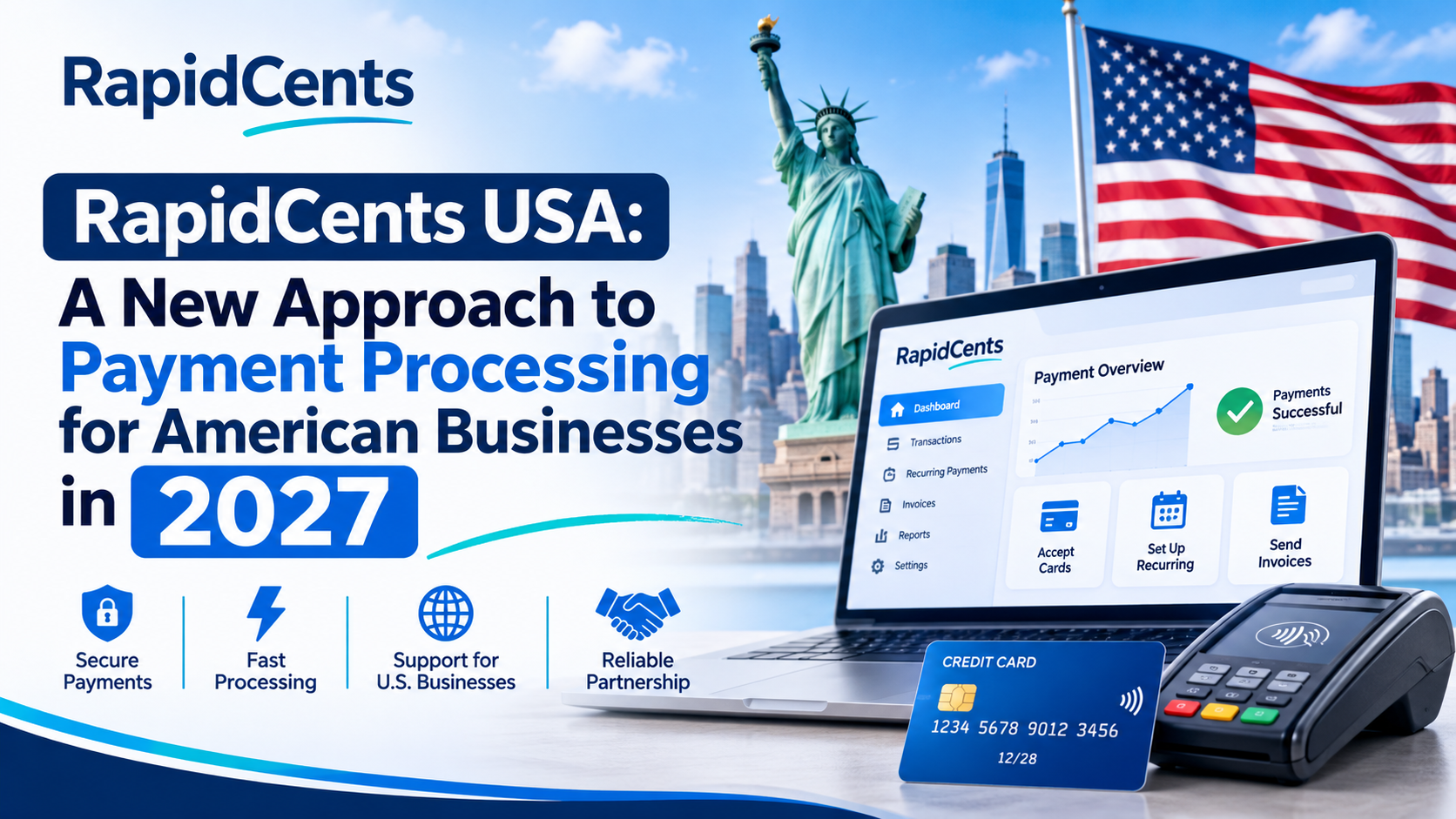
Changing payment processors shouldn’t mean replacing your entire business infrastructure. Yet for many American merchants, switching providers involves new terminals, software integrations, employee training, and unexpected expenses.
RapidCents wants to change that.
The Canadian financial technology company is expanding its presence in the United States with a comprehensive payment platform that brings together credit card processing, smart terminals, ready-to-use POS systems, online payments, chargeback protection, and developer APIs.
Its approach is built around a simple principle: businesses should have the freedom to choose how they accept payments without being restricted by their payment processor.
From Credit Card Terminals to Complete POS Systems
A restaurant, a jewelry store, and a wholesale distributor have very different payment requirements. Offering them the same solution doesn’t necessarily make sense.
RapidCents provides smart payment terminals supporting EMV chip cards, contactless payments, debit cards, and compatible digital wallets. Businesses looking for a complete point-of-sale solution can also access ready-to-use POS systems with inventory management, sales reporting, employee management, and customer records.
Restaurant configurations can include self-service ordering kiosks, kitchen display systems, and tableside payments.
For merchants who already have business software they prefer, RapidCents offers integration options for compatible third-party POS systems. There’s little reason to abandon a software investment simply because you’re changing payment providers.
Online Payments and One Centralized Merchant Dashboard
Not every business accepting online payments needs an e-commerce website. A contractor collecting a deposit or a distributor requesting payment for an invoice needs something much simpler.
RapidCents accommodates these situations through secure payment links, digital invoicing, virtual terminals, hosted checkout, e-commerce payment gateways, and automated recurring billing.
Business owners can manage transactions, refunds, deposits, invoices, subscriptions, and disputes through their online merchant dashboard.
For companies operating multiple locations, centralized reporting also makes financial reconciliation easier. Accounting teams can spend less time gathering payment information from different systems.
Chargeback Protection and Payment Security
An approved credit card transaction doesn’t guarantee that a merchant will keep the money. A disputed payment can cost a business its revenue, merchandise, and time.
RapidCents incorporates fraud screening, card verification, 3D Secure authentication, tokenization, and chargeback management into its payment platform.
These tools help merchants identify suspicious transactions before fulfilling orders and prepare supporting evidence when disputes occur.
The company’s security framework incorporates PCI DSS Level 1 and SOC 2 Type II controls. While no payment provider can eliminate every chargeback, having appropriate fraud prevention tools in place can help reduce avoidable losses.
Payment APIs and Proprietary Technology
RapidCents also serves software developers and enterprises that want to integrate payments directly into their own applications.
Its REST APIs, webhooks, software development kits, and sandbox environment support embedded payments, recurring billing, tokenization, refunds, and transaction management.
Two proprietary technologies reflect the company’s investment in payment innovation.
APPIE™ focuses on connecting payment functionality with compatible existing business software. Centa™ uses artificial intelligence to help merchants interact with supported financial and payment information through natural language.
Developers can explore integration capabilities through the RapidCents API documentation.
Transparent Payment Processing Fees
An advertised credit card processing rate rarely tells the whole story. Interchange fees, processor markups, transaction charges, equipment costs, and monthly expenses all contribute to what a merchant actually pays.
RapidCents offers interchange-plus pricing, separating underlying payment costs from the processor’s markup.
Consider a business processing $5 million annually. Reducing its effective processing rate by just 0.20 percentage points could save $10,000 per year, assuming other costs remain unchanged.
That’s why reviewing an actual merchant statement is often more valuable than comparing advertised rates.
Is RapidCents Available in the United States?
RapidCents’ U.S. offering covers payment processing for small businesses, retailers, restaurants, e-commerce companies, healthcare practices, wholesalers, franchise operators, software companies, and enterprise organizations.
American merchants evaluating alternatives to Stripe, Square, Clover, PayPal, or traditional merchant service providers can consider RapidCents for both in-person and online payment acceptance, subject to merchant approval and product availability.
A Payment Processor Worth Watching in 2027
What makes RapidCents an interesting addition to the American payment processing market is the breadth of its technology.
A small retailer can start with a credit card terminal. A growing franchise can introduce centralized payment management across multiple locations. An enterprise can integrate payments directly into its existing software.
The underlying platform is designed to accommodate those changing requirements.
For American businesses reviewing their payment arrangements in 2027, RapidCents offers an alternative that combines pricing transparency, payment security, proprietary technology, and the flexibility to grow without constantly changing providers.
Explore available payment solutions or request a processing cost comparison at RapidCents USA.